
This piece looks at safety across an entire category, not one product, and every regulatory or scientific claim links back to a primary source you can check yourself. Compounded and prescription medications discussed here are not FDA-approved, and the FDA does not verify the safety, effectiveness, or quality of compounded drugs before they reach the market. Last reviewed June 2026.
If you’ve been reading about peptides and come away more confused than when you started, you’re in good company. Most of the confusion isn’t your fault. It comes from a real conflation that even careful people make: treating “is this peptide safe” as one question, when it’s actually three.
Here’s the map I wish someone had handed me before I went down this rabbit hole. Safety in this world depends on three separate things: what the compound itself does in the body, what’s actually sitting in the vial you were sent, and whether a trained clinician is anywhere near the decision. Mix those together and you’ll misjudge the risk. Pull them apart, and the picture gets a lot clearer, and honestly a lot less scary to navigate.
Let’s take them one at a time, and I’ll show you what the primary sources actually say rather than what any seller wants you to believe.
First: what the compound itself does
Not all peptides carry the same kind of evidence behind them, and that’s worth sitting with before you go any further.
The GLP-1 metabolic peptides are the best-documented of the bunch, because the branded, FDA-approved versions went through large randomized trials. In the STEP 1 trial, semaglutide’s most common side effects were gastrointestinal, nausea and diarrhea mostly, generally mild to moderate and temporary, alongside a 14.9 percent mean weight reduction versus 2.4 percent for placebo at week 68 (Wilding et al., NEJM 2021). Tirzepatide told a similar story in SURMOUNT-1: a 20.9 percent mean reduction at the highest dose against 3.1 percent for placebo at week 72, with the same gastrointestinal pattern of side effects (Jastreboff et al., NEJM 2022).
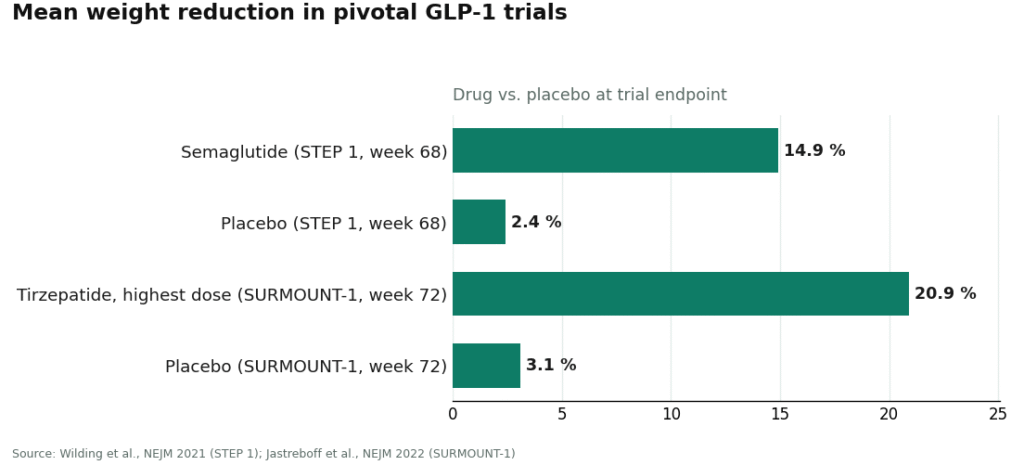
Here’s the part I want you to hold onto, though: those numbers describe the approved, finished products, given under careful trial conditions. They don’t automatically carry over to a compounded version, and they definitely don’t describe a “research use only” powder of unknown origin.
The recovery and longevity peptides live in a different, murkier evidence space. BPC-157, probably the one you’ve seen mentioned most, has mostly been studied in animals. Human clinical data are limited to a handful of small early trials (Sikiric et al., Pharmaceuticals 2024; Front Pharmacol 2021). That doesn’t mean it’s dangerous. It means nobody has really checked, in people, closely enough to say either way. And “we haven’t found harm” is not the same sentence as “this is safe,” even though they can sound alike if you’re skimming. The same goes for TB-500, GHK-Cu, and most of the other growth and longevity peptides you’ll encounter.
So the biology risk ranges from reasonably well-mapped (the approved GLP-1 drugs) to genuinely under-studied in humans (the recovery peptides). That range matters. Popularity is not the same thing as a proven safety margin.
Second: what’s really in the vial
This is the one that, in my reading of the evidence, causes most of the actual harm, and it has nothing to do with the molecule’s own biology.
The FDA has been blunt about it: a compounded drug that “is contaminated or contains too much active ingredient” “could cause serious injury or death” (FDA, understanding the risks of compounded drugs). This is why the agency treats what’s in the supply chain as a genuine safety issue, not just a bureaucratic one. And this risk shows up everywhere in the market. What changes is how much assurance stands behind what you’re getting.
On the supervised path, a licensed pharmacy operating to recognized standards provides that assurance. That’s real and it matters, but it has a ceiling even there: compounded drugs are still not FDA-approved, and as the agency puts it plainly, “FDA does not verify the safety, effectiveness or quality of compounded drugs before they are marketed” (FDA, compounding Q&A). A licensed pharmacy lowers your risk. It doesn’t erase the gap between that and an FDA-approved finished drug, and I don’t want to pretend otherwise.
On the research-chemical path, there’s often almost no assurance at all. Nothing is dispensed by a licensed pharmacy, and the only “proof” is usually a certificate of analysis written by the seller itself, which isn’t independent verification of anything. The FDA has specifically warned that unapproved and counterfeit GLP-1 products circulating outside the regulated supply chain may carry the wrong dose or contain impurities, leaving buyers with no real assurance of what’s inside (FDA, concerns with unapproved GLP-1 drugs). For something you’re injecting, an unknown dose or a possible contaminant isn’t a small detail. It’s the whole safety problem, regardless of how gentle the intended compound might be.
So here’s the honest read: the contents risk is present no matter where you buy, but it’s bounded by a licensed pharmacy on the supervised path, and largely unmanaged on the research-chemical path, where nobody independent is checking the vial.
Third: whether anyone’s actually watching
This one is easy to miss because it’s a risk of what’s absent, not what’s present.
A licensed clinician does things no product, however clean, can replace. They screen for contraindications. They check your other medications for interactions. They think about your history. They pick a sensible starting dose and adjust it based on how you respond. Take that clinician out of the picture, and none of that happens. You’re left screening yourself, dosing yourself, watching yourself, often working from forum advice rather than anything resembling evidence. For compounds like the recovery peptides, whose human safety data are already thin, losing that oversight doesn’t just add risk, it multiplies the uncertainty that was already there.
This is exactly why the favorable GLP-1 trial results happened under supervision in the first place: participants were screened, monitored, and titrated by clinicians. If you get the same molecule with none of that around you, you’re not really recreating the trial. You’re removing one of its load-bearing parts and hoping the results still hold anyway.
This is the specific gap the supervised route exists to close. FormBlends, as one example, is a licensed telehealth platform where independent licensed providers evaluate you and decide whether a prescription makes sense, with medication then coming from licensed 503A compounding pharmacies. I’m not describing this as a sales pitch, just as a structural fact: it keeps a clinician in the loop, which is precisely the thing the research-chemical route removes.
What the 2026 warning letters tell us
If you needed more proof that “research use only” isn’t the safety label it sounds like, 2026 delivered it.
On March 31, 2026, the FDA sent warning letters to peptide sellers after determining that products marketed as “research use only” were, in practice, unapproved new drugs meant for human use. In its letter to Gram Peptides, the agency stated that the company’s retatrutide and tirzepatide products were “unapproved new drugs under section 505(a)” of the Federal Food, Drug, and Cosmetic Act, adding that “despite statements on your product labeling marketing your products for ‘Research Use Only,’ and ‘not intended for human consumption, medical use, or veterinary use,’ evidence obtained from your website establishes that your products are intended to be drugs for human use” (FDA warning letter, Gram Peptides, 03/31/2026). The same day, Prime Sciences received a similar letter regarding its cagrilintide and mazdutide products (FDA warning letter, Prime Sciences, 03/31/2026).
What this tells you, practically: those products were reaching people without going through the process that establishes whether something is safe and effective, so nobody had actually verified their risk profile. And the “research use only” label you might have taken as a reassuring detail was, in the regulator’s own words, not matching how the products were being marketed or used. Read that disclaimer as a caution flag, not a comfort blanket.
Putting the map together
So here’s where that leaves you, all three pieces side by side.
How risky the compound is by nature depends on which one you’re talking about, best understood for the approved GLP-1 drugs, least understood for the recovery and longevity peptides. Whether the vial matches its label is a risk everywhere, but it’s bounded by a licensed pharmacy on the supervised path and largely unmanaged on the research-chemical path. And whether a clinician is watching is the defining difference between those two paths entirely.
None of this means the supervised route makes everything risk-free, and I wouldn’t want to leave you with that impression. Compounded peptides are still not FDA-approved. The recovery compounds are still thinly studied in people. But the supervised route does something real: it keeps two of the three risks, contents and oversight, inside boundaries. The research-chemical route leaves all three loose. For something you’re putting into your body with a needle, that difference is, to my mind, the single most important thing to understand here, and it comes straight from the FDA’s own published statements, not from any provider’s marketing copy.
Questions you might be asking right now
Are peptides safe to buy and use? There’s no single yes or no here, because safety depends on three separate things, not just the molecule itself. The compound’s own biology carries one kind of risk, what’s really in the vial carries another, and whether a clinician is involved carries a third. For most buyers, the biggest danger isn’t the peptide itself, it’s not knowing what’s actually in the product and not having anyone medically trained watching over you, both of which are worst on the research-chemical route and meaningfully bounded on the supervised one.
Which peptides have the most solid safety data behind them? The GLP-1 metabolic peptides, because the approved brand-name versions went through large randomized trials, STEP 1 for semaglutide and SURMOUNT-1 for tirzepatide, where side effects were mostly gastrointestinal. That data is about the approved products under trial conditions, and it doesn’t automatically transfer to a compounded or research-use version. The recovery and longevity peptides, BPC-157, TB-500, GHK-Cu, have mostly been studied in animals, so we don’t have a clear human safety picture for them yet.
Is a seller’s certificate of analysis the same as an independent check? No. On the research-chemical route, that certificate is typically written by the seller itself, which isn’t independent verification of anything. The FDA has warned that unapproved and counterfeit versions of these drugs, sold outside the regulated supply chain, may carry the wrong dose or contain impurities, with no real assurance of what you’re getting. On the supervised route, that assurance instead comes from a licensed pharmacy working to recognized standards.
If a pharmacy is licensed, does that make compounded peptides FDA-approved? No, and I want to be honest about both halves of that. A licensed pharmacy does lower the risk around identity, strength, and purity. But compounded drugs are still not FDA-approved, and the FDA does not verify their safety, effectiveness, or quality before they’re marketed. A licensed pharmacy brings the risk down. It doesn’t bring it down to the level of an approved, finished drug.
Why does having a prescriber matter if I can get the same thing without one? Because getting the same molecule without oversight means you’re removing one of the conditions that produced the good safety data in the first place, and just hoping the outcome still holds. A licensed clinician checks for contraindications, looks at your other medications, considers your history, and picks a sensible starting dose, then adjusts it based on how you’re doing. The favorable GLP-1 trial results came from people who were screened and monitored the whole way through. Take that away, and you’ve taken away part of what made those results trustworthy. The supervised route, FormBlends among them, exists specifically to keep a clinician in that loop, which is exactly what the research-chemical route skips.
What did the March 2026 warning letters actually mean for “research use only” products? They mean you should treat that label as a warning sign, not a comfort. On March 31, 2026, the FDA told sellers, including Gram Peptides and Prime Sciences, that products marketed as “research use only” were in fact unapproved new drugs meant for human use. Those products were reaching people without going through the safety and effectiveness review process, so their risk was never actually verified by anyone independent, and the reassuring label didn’t match how they were really being sold and used.
So, where can you actually buy peptides legally and safely?
Honestly, the safest legal path is the one that runs through an actual licensed physician who can write you a prescription, filled by a compounding pharmacy like FormBlends, working under pharmacist and medical oversight. Research-chemical vendors sell peptides labeled “not for human use,” which is a way of sidestepping FDA scrutiny altogether, and it leaves you with no quality guarantees, no accountability for dosing, and nobody to turn to if something goes wrong. That gap, more than the molecule itself, is where most of the documented harm comes from.
Where do people end up buying peptides for muscle growth, and what’s the risk there?
Most people land on research-chemical sites or gray-market supplement shops, often following a recommendation from a fitness forum. Independent lab testing of products from these sources has repeatedly turned up dosing inaccuracies, bacterial contamination, and unlisted ingredients. Peptides that touch growth hormone secretion also carry real cardiovascular and metabolic considerations that genuinely deserve a clinician’s attention, so buying them without a prescription stacks a clinical risk on top of a purity risk.
And for weight loss peptides, is a prescription actually required?
For the peptides with real evidence behind them, semaglutide and tirzepatide, yes, a prescription is legally required in the United States, no exceptions. Anyone selling GLP-1 related peptides without one is operating outside the law, no matter what their website claims. And those sellers offer none of the things that matter: no physician oversight, no consistent dosing, no monitoring for side effects like pancreatitis or gallbladder disease, which are real concerns even with the legitimate, prescribed versions of these drugs.
What does Reddit get right, and get wrong, about where to buy peptides?
Reddit threads can be genuinely useful for hearing what side effects real people noticed, or which products seemed off. What they can’t give you is verified purity data, a review of your medical history, or any accountability if a batch turns out to be contaminated. Treat crowdsourced vendor talk as a list of questions to bring to a clinician, not as a shopping guide.
References
- FDA, “Understanding the Risks of Compounded Drugs.” A compounded drug that is contaminated or contains too much active ingredient could cause serious injury or death.
- FDA, “Compounding and the FDA: Questions and Answers.”; the FDA does not verify their safety, effectiveness, or quality before marketing.
- FDA, “FDA’s Concerns with Unapproved GLP-1 Drugs Used for Weight Loss.” Unapproved and counterfeit GLP-1 products outside the regulated supply chain may carry the wrong dose or impurities, with no assurance of contents.
- FDA warning letter, Gram Peptides (March 31, 2026). Retatrutide and tirzepatide named as unapproved new drugs under section 505(a); “Research Use Only” framing rejected as a defense.
- FDA warning letter, Prime Sciences (March 31, 2026). Cagrilintide and mazdutide products named as unapproved new drugs.
- Wilding JPH, et al. “Once-Weekly Semaglutide in Adults with Overweight or Obesity.” N Engl J Med. 2021. STEP 1: gastrointestinal-dominant adverse events; 14.9% mean weight reduction versus 2.4% placebo at week 68. PMID 33567185.
- Jastreboff AM, et al. “Tirzepatide Once Weekly for the Treatment of Obesity.” N Engl J Med. 2022. SURMOUNT-1: gastrointestinal-dominant adverse events; 20.9% mean weight reduction at 15 mg versus 3.1% placebo at week 72. PMID 35658024.
- Sikiric P, et al. Review of BPC-157; effects drawn largely from preclinical and mechanistic studies, human clinical data limited. Pharmaceuticals (Basel). 2024. PMID 38675421.
- “Stable Gastric Pentadecapeptide BPC 157 and Wound Healing.” Front Pharmacol. 2021. Supporting evidence predominantly from animal models. PMC8275860.